TL;DR: Metal stamping is a cold-forming process that uses a press and die to shape sheet or coil metal into finished parts. It needs a serious upfront tooling investment, but once you’re past the breakeven volume the per-part cost drops to pennies.
Metal Stamping in One Minute — The Core Concept
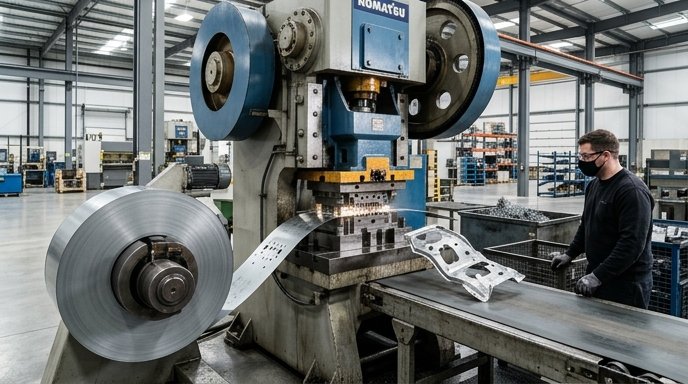
Metal stamping is a cold-forming process that uses a press and die to shape sheet metal into parts. A coil or flat blank feeds into the press, a hardened punch drives into a matching die, and the formed part ejects from the tool. Everything happens at room temperature, so the whole thing runs on mechanical force: shear, bend, stretch.
Press equipment scales with part size and material thickness. Small benchtop pneumatic or mechanical presses run 5 to 25 tons and typically kick out electrical contacts or small clips. The big automotive lines — AIDA, Schuler, that tier of equipment — use tandem or transfer presses in the 1,000 to 3,000+ ton range to form structural body panels.
The Operations Inside a Stamping Job
A single stamped part usually needs several distinct operations to reach its final shape. The operations fall into two camps: shearing (cutting the metal) and forming (bending or stretching it).
- Blanking: Cuts the rough outer perimeter of the part from the main coil.
- Piercing: Punches internal holes or slots. The removed slug is scrap.
- Bending: Deforms the metal along a straight axis, typically into V-shapes or U-shapes.
- Flanging: Bends the edge of a part to create a lip, usually for stiffness or assembly.
- Drawing: Stretches the metal into a 3D cavity to form cups or shells.
- Coining: Squeezes the metal under extreme pressure into a specific surface pattern, actually changing the material thickness.
- Embossing: Creates raised or sunken designs without changing the overall thickness.
Edge quality is where a lot of first-time buyers get caught off guard. Conventional blanking leaves a clean sheared edge on only about 30% of the material thickness. The remaining 70% fractures and breaks away, leaving a rough surface and a burr. If you need the edge to look pretty, that’s a conversation about secondary ops or fine blanking.
| Operation | Action | Typical Use Case | Tolerance Range |
|---|---|---|---|
| Blanking | Cuts outer profile | Creating the base flat part | ±0.005″ to ±0.010″ |
| Piercing | Cuts internal holes | Fastener holes, weight reduction | ±0.002″ to ±0.005″ |
| Bending | Angles the material | Brackets, chassis walls | ±1° to ±2° |
| Coining | Compresses material | Surface features, high-precision flattening | ±0.001″ to ±0.002″ |
Progressive, Transfer, and Single-Stage — Which Press Setup Fits Your Part
Progressive die stamping runs multiple operations in sequence on a single strip. Transfer stamping moves individual parts between stations. Single-stage runs one operation per press stroke. Which one fits comes down to annual volume, part size, and how deep the geometry goes.
Progressive Die Stamping
The metal stays attached to the main carrier strip as it moves through stations — piercing, bending, blanking. The final station cuts the finished part free. Progressive dies run fast, typically 100 to 800 strokes per minute. Good fit for high-volume orders (50,000+ parts/year) of small to medium components.
Transfer Die Stamping
The first station cuts the blank completely free from the strip. Mechanical fingers or robotic arms then shuttle the loose part from station to station. Slower (15 to 40 SPM), but you have to go this route for deep-drawn parts — the stretching involved would snap a progressive carrier strip in half.
Single-Stage Stamping
One die, one operation. Just blanking, or just bending. Operators or simple feeders load blanks by hand. Fits low-volume production (under 5,000 parts), or oversized parts that need a dedicated single-stroke press anyway.
Deep Drawing and Fine Blanking — The Specialty Cousins
Deep drawing and fine blanking play by different mechanical rules than conventional stamping, and the economics look different too.
Deep Drawing
Deep drawing pulls a flat blank into a deep 3D shell. Think beverage can, think automotive oil pan. The process needs a blank holder pressing down on the sheet edges to keep the material from wrinkling as the punch drags it into the die cavity. The physical limit here is the Limiting Draw Ratio (LDR). For standard drawing-quality steel the LDR sits around 2.0 to 2.2, which means the starting blank diameter can’t exceed roughly twice the diameter of the final drawn cup. Push past that and it tears.
Fine Blanking
Fine blanking produces parts with 100% cleanly sheared edges — no fracture zone. It takes a specialized triple-action press. A V-ring stinger clamps the metal tightly before the punch descends, and counter-pressure holds the part flat from below. The metal has no room to bend or tear during the cut. Tooling runs 20% to 40% more than conventional dies, but you often skip the secondary CNC milling or grinding step entirely on precision gears and latches, so the math usually works out on parts where edge quality is non-negotiable.
Materials — What Actually Stamps Well (and What Fights Back)
Sheet metal formability comes down to two mechanical properties, mostly: the n-value (strain hardening exponent) and the r-value (plastic strain ratio). Materials with an n-value above 0.20 and an r-value above 1.5 — your 1008 or 1010 low-carbon steels — stretch and form without necking or tearing.
Steel and Stainless Steel
Low-carbon cold-rolled steel is the baseline. Stainless, especially 304, work-hardens fast during forming. That means higher press tonnage and tool wear comes at you faster than it would with 400-series stainless or mild steel. I still spec 304 for a lot of corrosion-exposed brackets even when 430 would technically do the job — old habit, not always justified.
Aluminum
Aluminum alloys are all over the map on stampability. Soft stuff like 3003 or 5052-H32 bends easy. The high-strength aerospape alloys like 6061-T6 crack if you ask them to make a sharp bend, so you have to open up the minimum bend radius considerably.
Springback and Grain Direction
When metal bends, it tries to spring back toward flat. Mild steel gives you 1% to 2% springback, which you can basically ignore on anything non-critical. Advanced High-Strength Steels (AHSS) run 10% to 15%, and now you’re designing dies that heavily overbend the part just to land on target. Grain direction matters too: sheet metal comes off the rolling mill with a grain, and bending parallel to it causes cracking. Orient your bends perpendicular to the grain or expect scrap.
Cost Structure — Tooling, Press Time, and Where the Money Actually Goes
Stamping costs break into three buckets: the one-time tooling investment, raw material, and press time. Press time is measured in seconds per part, so the per-part number ends up tiny. The upfront tooling is where the bodies are buried.
A simple single-stage blanking die for a flat bracket runs somewhere between $1,500 and $5,000. A mid-complexity progressive die for an electrical contact lands in the $20,000 to $50,000 range. Large complex progressive or transfer dies for automotive components routinely clear $250,000, and I’ve seen quotes well past that for anything with deep draws and in-die welding.
This is why stamping is almost never the right answer for a 1,000-piece order. The breakeven against laser cutting and press-brake forming shows up somewhere around 10,000 parts per year, give or take depending on part complexity and your laser shop’s rates.
Tolerances, Tolerable Compromises, and Design-for-Stamping Rules
Standard stamping tolerances follow ISO 2768-m, typically holding ±0.005 inches for standard punched features and ±0.010 inches for bent flanges. If you want ±0.001 inches, you’re paying for precision tooling and a maintenance schedule to match.
Parts fail DFM review when they violate basic sheet metal physics. The failures are almost always the same handful of mistakes.
- Minimum Hole Diameter: At least 1.2 times the material thickness (1.2t) for steel, 1.5t for aluminum. Punches smaller than the material thickness snap under cutting pressure, often within the first few thousand strokes.
- Minimum Bend Radius: At least 1t for mild steel. For high-strength aluminum you want 2t to 3t or you’ll crack along the bend axis.
- Hole-to-Edge Distance: The web between a hole and the part edge needs to be at least 1.5t. Any closer and the metal bulges or tears during the punch.
- Bend Relief: Cuts adjacent to a bend have to be at least as wide as the material thickness. Otherwise the corners tear.
Metal Stamping vs. CNC Machining, Laser Cutting, and Casting — The Real Decision
Metal stamping is typically more cost-effective than CNC machining above roughly 10,000 parts per year for sheet-metal geometries. The right choice depends on annual volume, geometry complexity, and material thickness.
Prototyping and low-volume runs (1 to 5,000 parts) belong to laser cutting and press-brake forming — zero custom tooling, which is the whole point. CNC machining is for thick blocks and 3D geometries you can’t form from a flat sheet. Casting handles the big solid parts with internal voids, engine blocks and that family. Stamping wins when you’re making thin-walled, uniform-thickness parts at volume. Outside that lane, it’s usually the wrong tool.
| Process | Best Volume | Best Geometry | Tooling Cost | Per-Part Cost |
|---|---|---|---|---|
| CNC Machining | 1 – 1,000 | Complex 3D, thick blocks | Zero / Low | Very High |
| Laser + Brake | 100 – 5,000 | 2D profiles, simple bends | Zero | Medium |
| Metal Stamping | 10,000+ | Uniform thickness, thin sheet | High ($5k – $100k+) | Very Low |
| Die Casting | 5,000+ | Complex 3D, non-uniform walls | Very High | Low |
FAQ
How much does a metal stamping die cost?
Anywhere from $1,500 for a simple single-stage blanking tool to over $250,000 for a complex multi-station progressive die in automotive work. Price scales with part size, material thickness, and the number of operations.
What’s the minimum order quantity for metal stamping?
Physical minimums depend on the supplier, but the economic MOQ is typically around 10,000 parts. Below that volume, the tooling cost spread across the run makes per-part price uncompetitive against laser cutting or CNC. Some shops will take smaller runs if you’re bringing them future volume, but you’ll pay for the tooling either way — amortized into the piece price or billed upfront, and the latter is usually cheaper in the long run if you can swing the cash.
What tolerances can metal stamping hold?
Conventional stamping routinely holds ±0.005″ on punched holes and ±0.010″ on bent features. Fine blanking or coining can get you down to ±0.001″ if you need it.
Is metal stamping the same as metal forming?
No. Stamping is a subset. Forming is the broad category — forging, rolling, extrusion all count. Stamping specifically means cold-forming sheet metal with a press and die.