A complete stamping RFQ has seven pieces: a 2D print plus a 3D STEP, material grade and temper, estimated annual usage, surface finish, PPAP level, a target price, and where the parts need to land. Send a clean package and you’ll see quotes back in a week or two. Send half of one and you’ll either wait three weeks or get quietly dropped to the bottom of the stack.
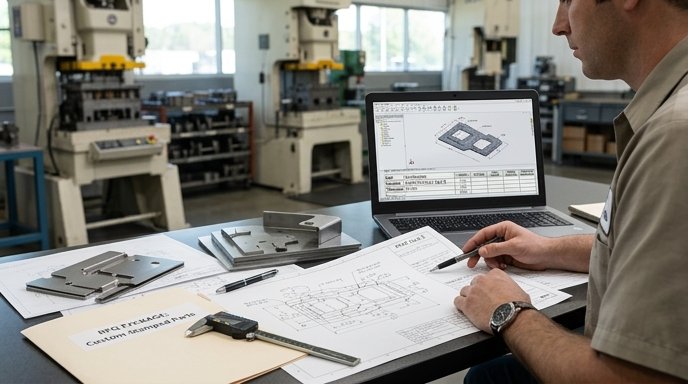
What a Stamping Supplier Actually Reads First (And What They Ignore)
A quoting engineer does not read your RFQ top to bottom. They scan for disqualifiers, because the first question is always whether the job even fits the press lineup and the shop’s business model.
The scan goes roughly in this order:
- Estimated Annual Usage. No EAU, no quote. A 500-piece run belongs on a laser or in soft tooling. A 500,000-piece run belongs in a progressive die. Those are two different companies, sometimes.
- Material grade and thickness. Does the thickness blow past the press capacity? Is the alloy something ugly like Inconel that needs special tooling?
- Tolerances. Quick look at the title block, then a hunt for anything under ±0.005″.
- Secondary ops. Plating, heat treat, welding. Anything that has to leave the building.
- Delivery timing. First-article date against the current tool room backlog.
What gets ignored: the generic boilerplate in the title block. “Remove all burrs” and friends. Suppliers price what’s actually called out on the features, not the template fine print you inherited from whoever drew the part in 2011.
The 7-Part RFQ Package
Seven things. Miss one and the supplier either assumes, which means they pad, or they email you and your quote slides back two days per round-trip.
| Required Element | Why the Supplier Needs It | Common Engineering Mistake |
|---|---|---|
| 1. 2D Drawing & 3D STEP File | 2D gives tolerances; 3D lets them run strip layout and flatten the blank fast. | Sending only the 3D. A STEP file has no tolerance limits and no finish callout. |
| 2. Material Spec & Temper | Drives press tonnage and die wear. | “Carbon steel.” Call out the actual spec, something like ASTM A1008 CS Type B. |
| 3. Estimated Annual Usage (EAU) | Picks the tooling strategy and sets the price breaks. | “Marketing doesn’t know yet.” Give a low, mid, and high. Anything beats silence. |
| 4. Surface Finish | Decides whether parts need tumbling, deburring, or plating after the press. | Specifying “zero burrs.” Standard allowance is around 10% of material thickness. |
| 5. Tolerance Callouts | Drives the number of stations in a progressive die. | Blanket ±0.001″ across the whole part. |
| 6. Compliance & PPAP | Sets the inspection and paperwork burden. | Asking for AIAG PPAP Level 5 when Level 3 is what everybody actually runs. |
| 7. Packaging & Logistics | Steel is heavy and freight eats margin. | Leaving packaging blank. Loose in a gaylord is cheap. Custom dunnage is not. |
Tooling Cost Math — Why the “Expensive” Quote Might Be Cheaper
Amortize the tooling. That’s the whole trick:
Total unit cost = piece price + (tooling ÷ (EAU × program years))
If you compare bottom-line piece prices without doing this math, you will pick the wrong supplier almost every time. Here’s where I’d push harder than most RFQ guides do, because this is the single biggest source of avoidable cost on a stamping program.
Take a part with an EAU of 100,000, five-year program. 500,000 pieces total.
Supplier A quotes $5,000 for soft tooling and $0.80 per piece. Supplier B quotes $40,000 for a hard progressive die and $0.20 per piece. On the surface, A is a quarter the tooling cost and looks like the safer bet, especially if you’re the one who has to walk the capital request through finance. Run the math and A lands at $0.81 all-in. B lands at $0.28. Over the life of the program, B saves you about $265,000. You’ll spend a morning defending the $40K check and then nobody will remember by Q3.
The thing most RFQ writeups skip: tooling life. A standard D2 die will give you somewhere around a million hits before it needs serious sharpening or a rebuild. If your program is 5 million parts, that die gets refurbished four or five times across its life, and somebody is paying for that. Ask, in writing, whether maintenance and replacement are baked into the piece price or whether you’ll get a surprise invoice in year three. The answer tells you a lot about the supplier, honestly, more than any capability brochure will.
And don’t forget steel price pass-through. Separate conversation, but a real one.
Spec Choices That Secretly Double Your Price
Engineers over-spec. Suppliers price what’s on the print. Those two sentences explain probably 80% of unnecessary stamping cost.
Standard stamping tolerance is ±0.005″. Call out ±0.001″ and the stamper can’t hold it off the press, period, which means a secondary shaving or CNC op, which roughly doubles the piece price depending on the feature.
On material: 304 stainless is the default everyone writes down. 301 is more ductile, work-hardens nicely, and in a lot of stamping applications is the better pick. Switching can bring down material cost and extend die life. Not always the right call, but worth asking.
Burrs: “completely free of burrs” sends your part to a vibratory tumbler. A standard burr allowance, roughly 10% of material thickness, keeps the part on the press and saves you a routing step.
Progressive Die vs. Deep Draw vs. Fourslide — Different RFQs, Different Info
Different processes, different data in the RFQ.
Progressive die. High volume, complex geometry, usually 50,000 EAU and up. Send the 3D STEP so they can run strip layout. Tooling runs $10,000 to over $100,000 depending on station count.
Deep draw. Cylindrical or box shapes where depth exceeds diameter. Specify the draw ratio and whether you’ll accept wall thinning. These parts live on specialized presses.
Fourslide / multislide. Wire forms, clips, flat springs. Tooling can run around half the cost of a progressive die. If your part is a small clip with a couple of bends, ask whether it’s a fourslide candidate before anybody cuts a progressive.
Obviously you wouldn’t run a deep draw program on a gap-frame press, but I’ve seen it quoted that way more than once.
Reading the Quote — Line Items That Signal Trouble
A complete quote breaks out eight things: tooling, tiered piece price, setup, secondary ops, packaging, inspection, lead time, and tooling ownership.
Red flags:
- No tooling ownership clause. Customer-owned tooling means you can pull the die and move it. Supplier-owned means you paid for a die you can’t take with you. Even on customer-owned tools, expect a maintenance fee in the 10-15% range annually.
- Piece price with no volume tiers. You want to see 10k, 50k, 100k. One flat number means they didn’t amortize setup properly, which means they’ll come back to renegotiate.
- “TBD” on freight or packaging. Heavy steel plus long freight lane equals a nasty surprise.
What Separates a 5-Day Quote From a 3-Week Quote
Per the PMA Business Conditions Report, quoting backlogs move with skilled labor availability, and in my experience the swing between a well-staffed shop and a short-handed one is bigger than most buyers appreciate.
Five-day turnaround: the package is complete. Engineer drops the STEP into their software, gets the flat blank, pulls current coil pricing, and builds the tooling estimate between other work.
Three-week turnaround: they have to RFI you. Missing dimension on the PDF, so they email. You take two days. They come back and the material callout is to a spec that got superseded in 2019, so they email again. Every round trip pushes you back in the queue, and the queue doesn’t wait for you.
Comparing Quotes Without Getting Fooled
Three quotes come in. Before you look at the bottom line, normalize.
INCO terms. Supplier A quotes $0.50 EXW. Supplier B quotes $0.55 DDP. Under EXW you own the freight and the risk the second the parts cross the dock. B is probably cheaper once you add it up.
PPAP. A includes Level 3 in the tooling. B charges a separate line for FAI and PPAP paperwork, often around $1,500. Add it in before you compare.
Lead time. A says 8 weeks for tooling. B says 14. If your line is waiting on parts, the “cheaper” 14-week tool is the most expensive thing in the building.
I still lean toward domestic suppliers for anything under 250K EAU even when the offshore quote looks better on paper. Old habit from the auto days, probably not fully justifiable on a spreadsheet.
FAQ
How much does a custom stamping die cost right now?
Depends on the process. Soft tooling for low-volume work runs roughly $2,000 to $5,000. Hard progressive dies sit in the $10,000 to $100,000+ range. The number inside that range is driven by station count, part complexity, material thickness, and whether the shop has to buy or build any of the detail components. Ballpark figures only; get a real quote.
Do I need a 3D CAD file to get a stamping quote, or is a 2D drawing enough?
Both. The 2D carries the legal requirements, tolerances, material, finish. The 3D STEP lets the supplier flatten the part fast and run strip layout. Send one without the other and you’re adding days to the response.
How long should a stamping RFQ take to come back?
Anecdotally, a clean package to a mid-size domestic shop comes back in five to ten business days. Progressive die work or anything with outsourced plating can push to two or three weeks.
Who owns the stamping tooling after it’s built — me or the supplier?
Negotiable, and it has to be in the quote. Customer-owned means you paid full NRE and the die is yours to move. Supplier-owned usually lowers upfront cost and locks you to that vendor.